
Application of Support Vector Machines and Holt Winters Exponential Smoothing Modelling Approaches in Airlines Passengers’ Time Series Forecasting
Article Sidebar
Main Article Content
Abstract
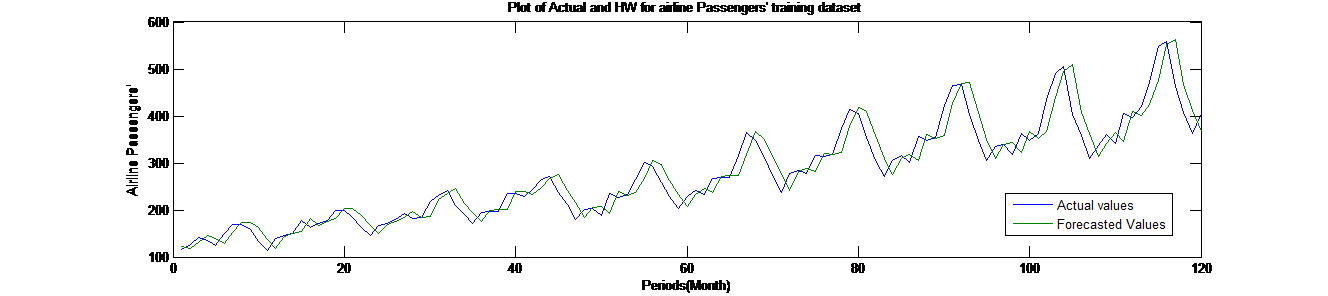
This paper examines the application of Artificial Intelligence (AI) and statistical methods which are support vector machine (SVM) and Holt Winters Exponential Smoothing (HW) models respectively in time series forecasting. The aim of this paper is to examine the feasibility of applying the two models to airlines passenger’s data so as to determine the more efficient among the two models. These two models are very important in the field of time series forecasting, SVM deals with linear data while HW deals with nonlinear patterns. The results indicate that using the criteria evaluation performance HW model has Mean Square Error (MSE) of 996.10, Mean Average Error (MAE) of 44.64 and coefficient of correlation (R) of 0.75 while SVM model has MSE of 925.922, MAE of 25.24 and R of 0.89. These results show that using the time series for the airlines passenger, SVM model is the most efficient having the least error of performance and the highest coefficient of correlation. SVM model has therefore proved to be superior to the HW model and therefore recommended to be used in forecasting the airlines passengers’ data because of its advantage over HW model to forecast the airlines passengers’ data.
Downloads
Article Details
References
Changxiu, Z. C. and Xu xiaoling, W. W. (2002). A novel approach based on support vector machine to forecasting the quality of friction welding. 4th World congress on intelligent control and automation.
Chen, K., & Wang, C. (2007). A hybrid SARIMA and support vector machines in forecasting the production values of the machinery industry in Taiwan. 32, 254–264. https://doi.org/10.1016/j.eswa.2005.11.027
Cordeiro, C., & Neves, M. (2009). Forecasting time series with Boot. EXPOS procedure. Revstat, 7(2), 135–149.
Cortes, C., & Vapnik, V. (1995). Support-Vector Networks. 297, 273–297.
Dawson, C. W., Abrahart, R. J., & See, L. M. (2007). HydroTest: A web-based toolbox of evaluation metrics for the standardised assessment of hydrological forecasts. Environmental Modelling and Software, 22(7), 1034–1052. https://doi.org/10.1016/j.envsoft.2006.06.008
Gelper, S., Fried, R., & Croux, C. (n.d.). Computational aspects of robust holt-winters smoothing based on m -estimation. 2001, 1–13.
Hyndman, L. R. J. (2014). Forecasting : Principles & Practice. September.
Ismail, Z., Ismail, Z., Yahya, A., & Shabri, A. (2009). Forecasting Gold Prices Using Multiple Linear Regression Method. American Journal of Applied Sciences, 6(8), 1509–1514. https://doi.org/10.3844/ajassp.2009.1509.1514
Kalekar, P. S., & Bernard, P. (2004). Time series Forecasting using Holt-Winters Exponential Smoothing Under the guidance of. 04329008, 1–13.
Makatjane, K. D., & Moroke, N. D. (2016). COMPARATIVE STUDY OF HOLT-WINTERS TRIPLE EXPONENTIAL SMOOTHING AND SEASONAL ARIMA : FORECASTING SHORT-TERM SEASONAL CAR SALES IN SOUTH AFRICA. 6(1), 71–82.
Pai, P., Lin, K., Lin, C., & Chang, P. (2010). Expert Systems with Applications Time series forecasting by a seasonal support vector regression model. Expert Systems With Applications, 37(6), 4261–4265. https://doi.org/10.1016/j.eswa.2009.11.076
Propper, C., & Wilson, D. (2003). The use and usefulness of performance measures in the public sector. Oxford Review of Economic Policy, 19(2), 250–267. https://doi.org/10.1093/oxrep/19.2.250
Rahman, H., Salma, U., & Hossain, M. (2016). Revenue Forecasting using Holt – Winters Exponential Smoothing. December.
Shcherbakov, M. V., & Brebels, A. (2013). A Survey of Forecast Error Measures. 24(4), 171–176. https://doi.org/10.5829/idosi.wasj.2013.24.itmies.80032
Sujjaviriyasup, T. (2013). Hybrid ARIMA-Support Vector Machine Model for Agricultural Production Planning. 7(57), 2833–2840.
Supriatna, A., Susanti, D., & Hertini, E. (2017). Application of Holt exponential smoothing and ARIMA method for data population in West Java Application of Holt exponential smoothing and ARIMA method for data population in West Java. https://doi.org/10.1088/1742-6596/755/1/011001
Tian, Y., Shi, Y., & Liu, X. (2012). Recent advances on support vector machines research. 18(1), 5–33. https://doi.org/10.3846/20294913.2012.661205
Vapnik, V. N. (1999). An Overview of Statistical Learning Theory. 10(5), 988–999.
Wang, L. (2005). Support Vector Machines : Theory and Applications.
Wang, S., Feng, B., & Liu, G. (2013). Application of seasonal time series model in the precipitation forecast ✩. Mathematical and Computer Modelling, 58(3–4), 677–683. https://doi.org/10.1016/j.mcm.2011.10.034
Zhang, G. P. (2003). Time series forecasting using a hybrid ARIMA and neural network model. 50, 159–175.